
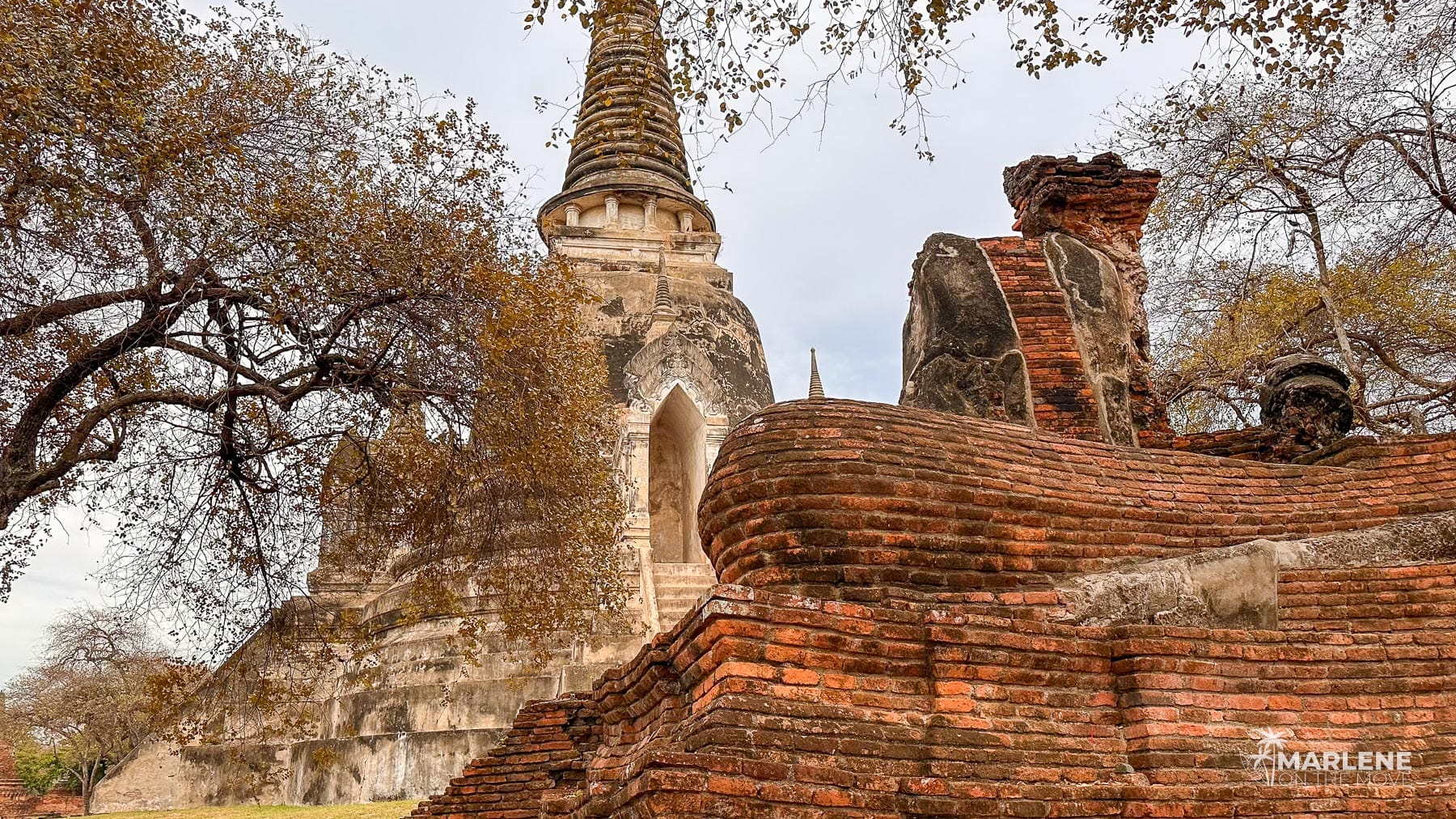
At its peak in the 17th century, Ayutthaya had over a million inhabitants. London had around 200,000. It was a center of global trade, receiving merchants from Portugal, China, the Netherlands, and India. A place where the world converged.
In 1767, the Burmese army arrived and burned almost everything to the ground.
I visited Ayutthaya while leading a tour group for Leva-me, a Portuguese travel agency, and the experience stayed with me.
What is Ayutthaya
Ayutthaya was the second capital of the Siamese Kingdom, founded around 1350. It became a UNESCO World Heritage Site in 1991. The archaeological park spans 289 hectares and contains dozens of temple ruins, Buddhist monasteries, and structures that were synonymous with power and wealth for centuries.
What surprises you when you actually get there is the space. This isn’t a site where you’re shoulder-to-shoulder with strangers in a narrow corridor. The ruins are scattered across a modern city, separated by streets and open ground. There’s a quiet between them that doesn’t feel like abandonment. It feels like something else entirely.
Getting there from Bangkok
The most common option is a minivan or car, departing from various points around Bangkok. The journey takes roughly 1.5 to 2 hours, depending on traffic. There’s also the train, slower but with its own appeal, departing from Hua Lamphong station.
If you’re joining an organized tour, transport is usually included. If you’re going independently, it’s worth booking your seat in advance, especially on weekends.
What to see at the archaeological park of Ayutthaya
Wat Phra Mahathat: The Buddha in the tree
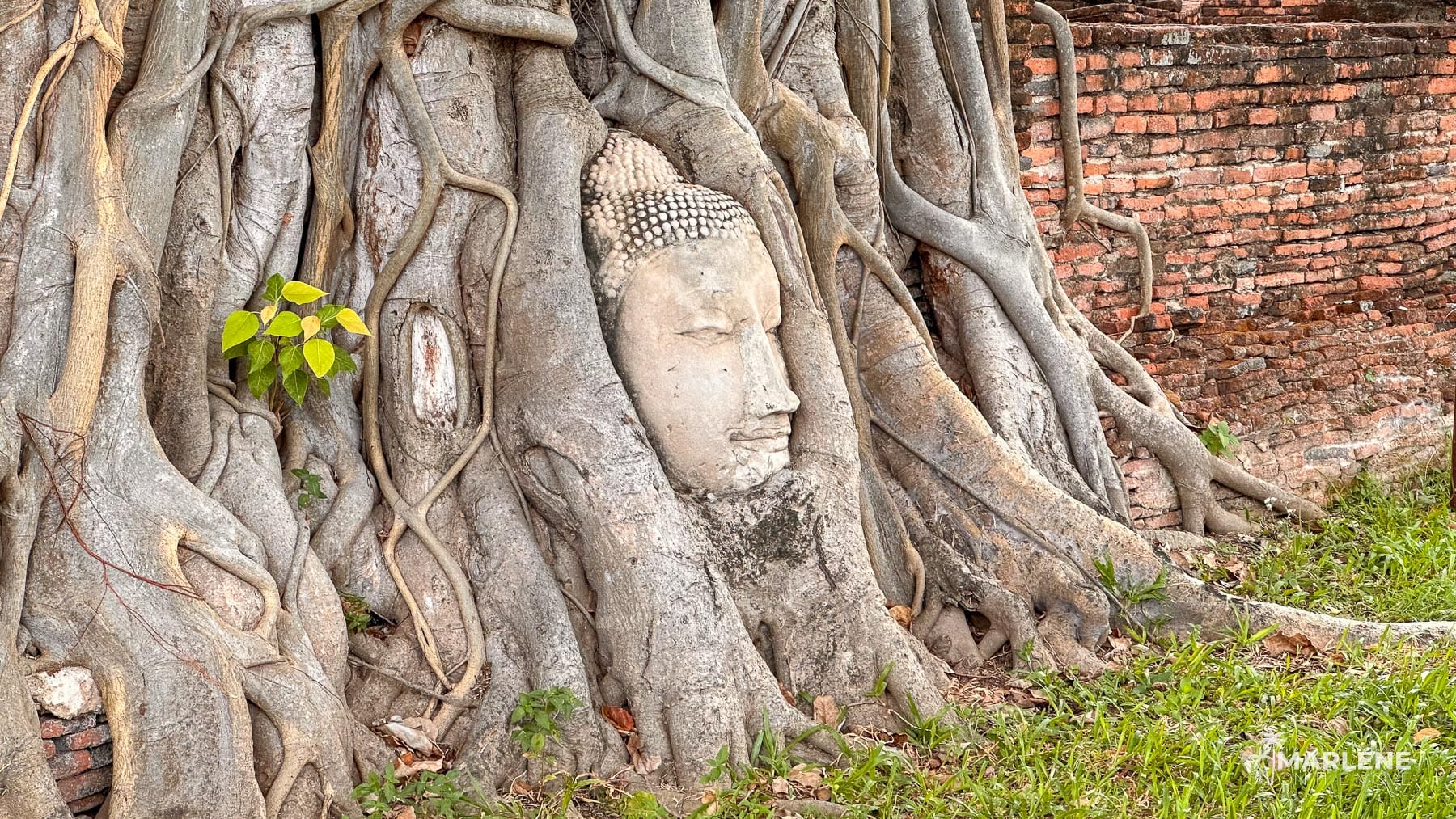
There’s one image of Ayutthaya that appears in every travel guide, every search result, every list of things to see in Thailand: a Buddha head wrapped in the roots of a tree, face serene, eyes closed, somehow at peace.
It’s at Wat Phra Mahathat. And when you see it in person, your first instinct is to try and figure out how it got there.
The short answer: nobody knows for certain. Wat Phra Mahathat was built in the 14th century and destroyed during the Burmese invasion of 1767. Buddha statues across the site were deliberately decapitated. This particular head is believed to have fallen to the ground during the destruction, and over the following centuries, a nearby sacred fig tree slowly grew its roots around it, eventually enveloping it completely.
There’s a competing theory: a thief hid the head there intending to come back for it, and never did. The tree finished the job.
What I saw was a quiet line of people circling the image, cameras raised, and a guard ensuring everything was handled with the respect the site demands. The rules are real and enforced: you don’t raise your face above the Buddha’s level when photographing, you don’t turn your back to it. You kneel or sit on the ground. You keep the noise down.
It’s one of the most photographed spots in Thailand. It doesn’t feel like a tourist trap. It feels genuine.
Wat Phra Si Sanphet: The royal temple
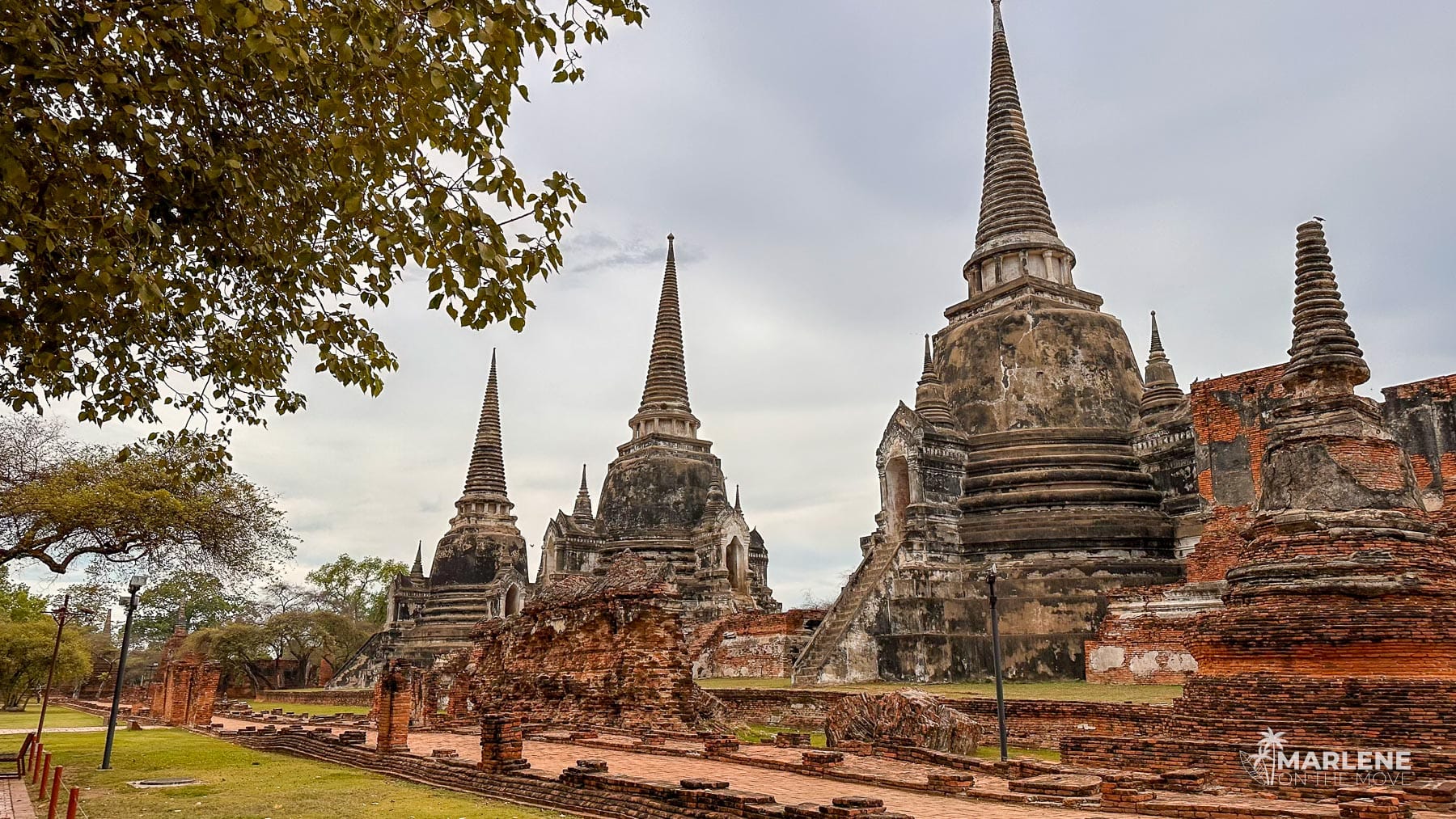
Wat Phra Si Sanphet was the royal temple of Ayutthaya, the equivalent of Wat Phra Kaew in Bangkok, which was later built as a deliberate attempt to replicate its grandeur. The three chedis that define the park’s skyline hold the ashes of three Ayutthayan kings.
This is the kind of place where you start to understand the scale of what was lost. The towers are intact in form, but everything that surrounded them, the palaces, the passageways, the gilded details, disappeared in 1767 when the Burmese melted the gold down.
Wat Ratchaburana
Built in the 15th century, Wat Ratchaburana has a family story behind it that stays with you: it was commissioned by the seventh king of Ayutthaya in memory of his two older brothers, who killed each other in single combat over the right to the throne.
Their ashes rest in a double chedi. It’s one of the best-preserved temples in the park and one worth not skipping.
Wat Chaiwatthanaram: Sunset by the river
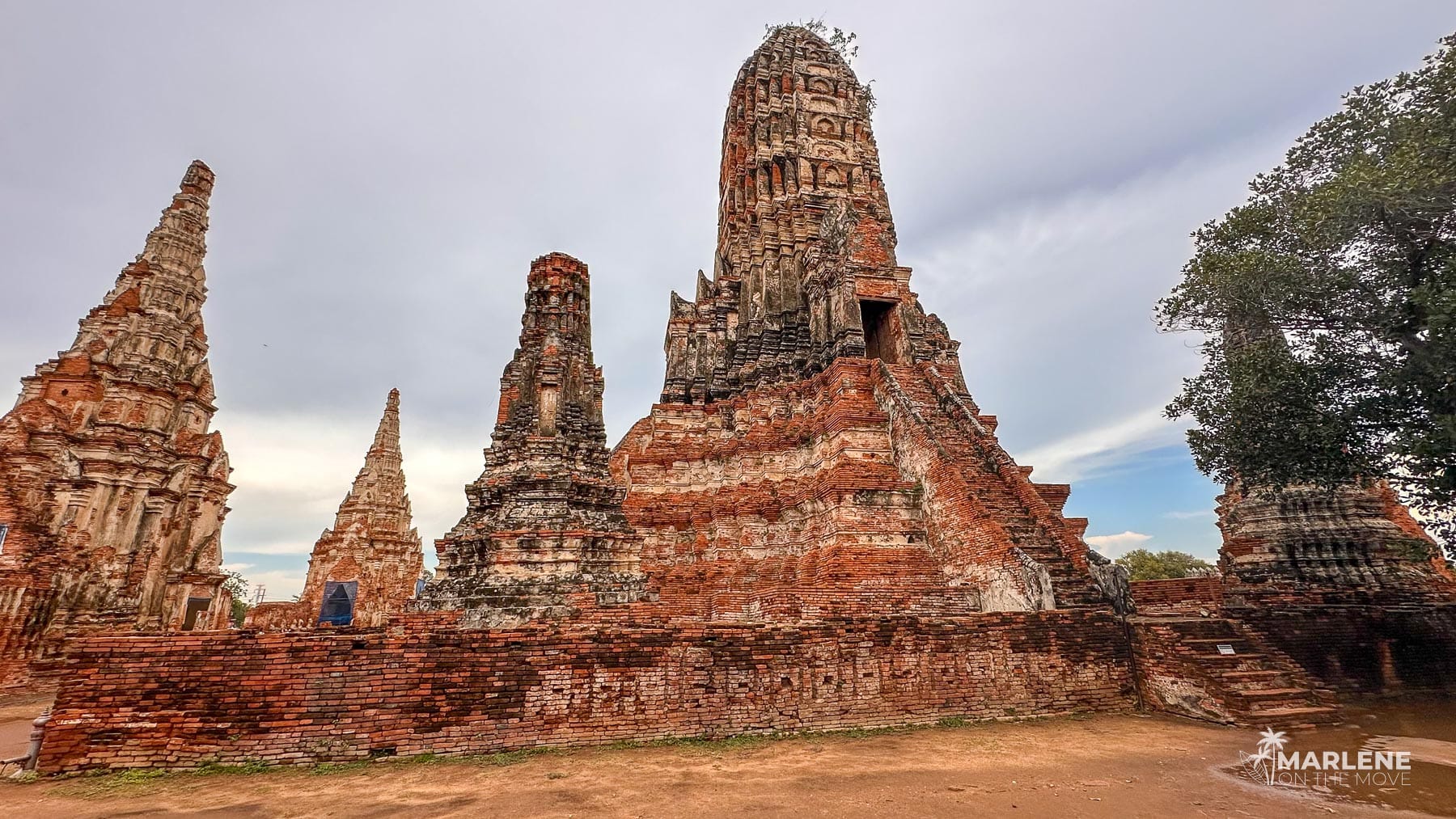
The most photogenic of the group, especially at the end of the day. Khmer-influenced in its architecture, designed along the lines of Angkor Wat in Cambodia, it sits on the bank of the Chao Phraya River, just outside the park’s central cluster. If time allows, it’s worth the detour.
What caught me off guard: The absence of crowds
Ayutthaya is a UNESCO World Heritage Site. It has three iconic chedis, the most photographed Buddha in Thailand, dozens of temple ruins spread across the landscape. By every measure, it should be packed.
It wasn’t.
There were people, of course. But there was also room to move, to stop, to actually look at something without being pushed from behind. In a world where any spot with a hashtag turns a visit into a three-hour queue, Ayutthaya felt like an exception.
Part of it may be the format: the ruins are spread over several kilometers rather than concentrated in a single enclosure. Part of it is probably that Ayutthaya continues to be treated as a stopover rather than a destination. Most people come for the day from Bangkok and leave by late afternoon. That’s enough to understand the essentials, but it always leaves something unfinished.
Is It Worth Going with a Guide to Ayutthaya?
Yes. And I’m not saying that out of professional obligation.
Walking through Ayutthaya’s ruins without context is looking at very old, very well-placed stones. With context, you get the history of the kingdom, the meaning behind the different tower styles, what exactly happened in 1767, what each temple represented politically. It becomes a completely different visit.
A local guide or an organized tour changes the experience. It’s not a convenience question. It’s a depth question.
What about surf?
Ayutthaya is not a surf destination. It sits 80 km inland from Bangkok, surrounded by rivers. If you’re traveling through Thailand and want to add surf to the mix, your closest realistic options are in the south: Koh Lanta has modest beginner-friendly conditions between October and April, and Phuket’s west coast has more consistent surf during the same window. That said, Thailand isn’t known for reliable waves, so manage expectations accordingly.
Travel Notes
How long to spend: A full day (6-8 hours) is ideal. You can cover the highlights in half a day, but more time means seeing the temples without rushing and, if the timing works out, catching Wat Chaiwatthanaram at sunset.
Getting there from Bangkok: Car or minivan (roughly 1.5 hours from various pickup points around the city) or train (around 2 hours, departing from Hua Lamphong, slower but worth it). Organized day tours with transport included are also a solid option if you’d rather not manage the logistics. You can search for options on GetYourGuide.
Where to stay: If you’re spending the night, the riverside area in central Ayutthaya has good options close to the park. Search on Booking.com for what fits your style.
Opening hours: Hours vary by temple. Most open somewhere between 8:00 and 8:30 AM and close between 4:30 and 6:00 PM. It’s worth checking ahead, particularly if you’re planning a late afternoon visit.
What to wear: Clothing that covers shoulders and knees is expected at the temples. Given the heat, a lightweight scarf or sarong is more practical than heavy trousers.
Heat: The rainy season (June through October) is hotter and more humid. Bring water, use sunscreen, and start early. The midday heat is serious.
Internet: Thailand has solid data coverage across most tourist areas. If you need an eSIM for the trip, Holafly offers unlimited data plans for Thailand, and you get 5% off.
Travel insurance: Don’t travel to Thailand without insurance. Private healthcare can be good but expensive without coverage. Heymondo is what I use and recommend. And for being a Marlene On The Move reader, you get a 5% discount.
Final tip: Wat Phra Mahathat is quietest mid-morning, after the first wave of tour groups has moved on to other temples. If you’re going independently, save it for that window.
Have you been to Ayutthaya? Tell me about it in the comments.
Travel Tool Box
These are my go-to tools to make my trips more complete at the best prices. Enjoy some of the perks of being one of my readers.
By using these links you’re also contributing for the maintenance of this blog and for that I thank you so much!
Heymondo
Book your travel insurance with a 5% discount.
Holafly
Get your unlimited eSIM with a 5% discount.
Booking.com
The best stays worldwide at the best prices.
GetYourGuide
Enjoy the best tours and entertainment each destination offers.
Skyscanner
Find the best flight at the best price for your next trip.
Hostelworld
Enjoy the best hotels around the world for a fun experience.
DiscoverCars
Book your car at the best prices and go explore.
Compensair
Don’t let your canceled flight ruin your vacation.