
I’ve been leading tours to Morocco for many years. I know the medina alleys better than some of my own neighbourhoods at home, I know which stalls have the best spices, which hours to avoid Jemaa el-Fna, and how to negotiate in the souks without losing your mind. And I’ve always told everyone who travels with me the same thing: do a hammam in Marrakech. It’s non-negotiable. It’s Morocco in its most essential form.
The problem? I had never done one myself.
This trip, I decided that was going to change. No particular reason. Maybe I’d grown tired of recommending something I didn’t actually know from the inside. Or maybe it was plain curiosity that had somehow never turned into action. Either way, I booked one at the hotel where I was staying, and I went.
What followed wasn’t quite what I expected.
Hammam: much more than a Turkish bath
Most travel guides call it a Turkish bath, but that label doesn’t really do justice to what the hammam is in Morocco. Its origins are older and more layered than the name suggests.
The word hammam comes from Arabic and means, literally, house of bathing. The practice inherited its structure from ancient Roman thermae, a system of progressively hotter rooms the Romans built across their empire, and was later adapted and deeply woven into Islamic culture.
In the 7th century, Prophet Muhammad taught that physical purity was an extension of spiritual purity, and hammams began appearing throughout the Islamic world, often right beside mosques. In Morocco, the ritual became especially embedded through the Maliki legal tradition, which places particular emphasis on purification, and for centuries hammams served not just as places of hygiene but as social hubs, particularly for women, who gathered there to talk, share news, and mark important moments in life.
Today, with private bathrooms in most Moroccan homes, the social role of the hammam has shifted. But the tradition hasn’t disappeared, but adapted. Public hammams still operate in the medinas, used by locals, running in parallel with a more tourist-oriented version: spas, riads and hotels that offer the same ritual with more comfort and fewer unknowns.
Two types of hammam: which one is right for you?
In Marrakech, you have two main options for experiencing this ritual.
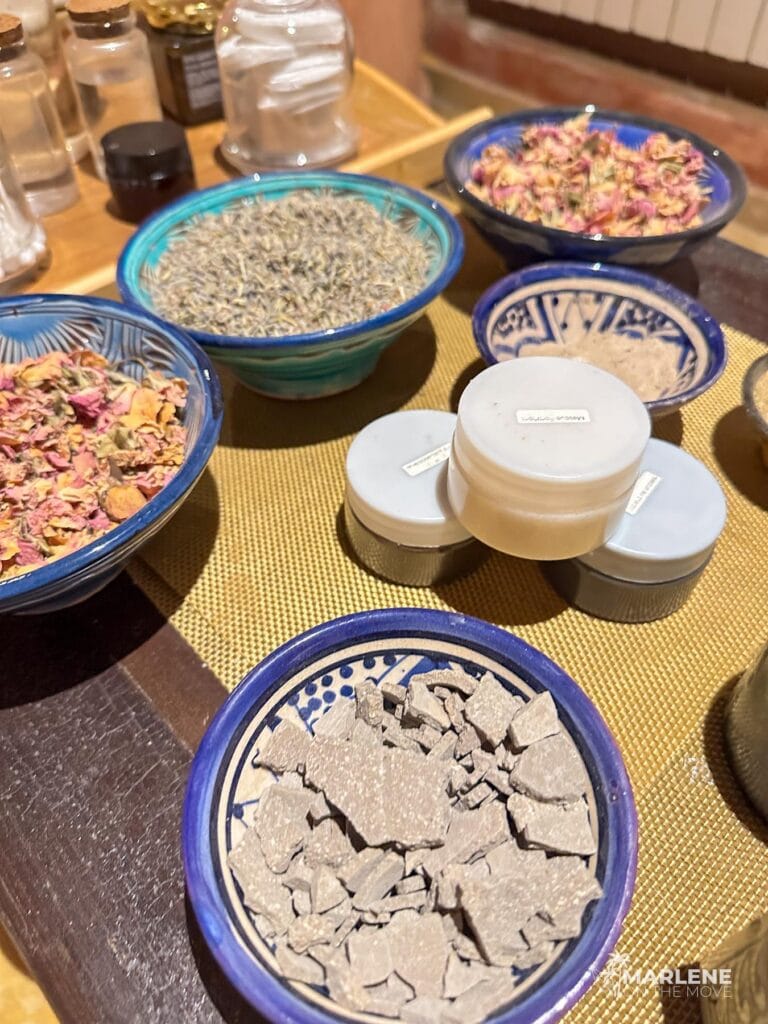
Traditional hammams are the ones locals use. They’re public bathhouses tucked into the medina streets, with no real signage for tourists, where the experience is completely authentic but also more demanding. You need to bring your own supplies: black soap, the kessa exfoliation glove, ghassoul clay. Not all of them accept visitors from outside, and without knowing Arabic, it can be hard to follow what’s happening or know what to do next.
The second option — which is the one I chose — is a spa, hotel or wellness centre that offers the hammam in a more structured format. Everything is provided, a therapist guides you through the process, and the environment is controlled. You lose some of the raw authenticity of the public hammam, but you gain ease and accessibility, especially if it’s your first time.
Neither choice is wrong. It comes down to what you’re looking for and how comfortable you are with the unfamiliar.
What actually happens inside a hammam in Marrakech (no filter)
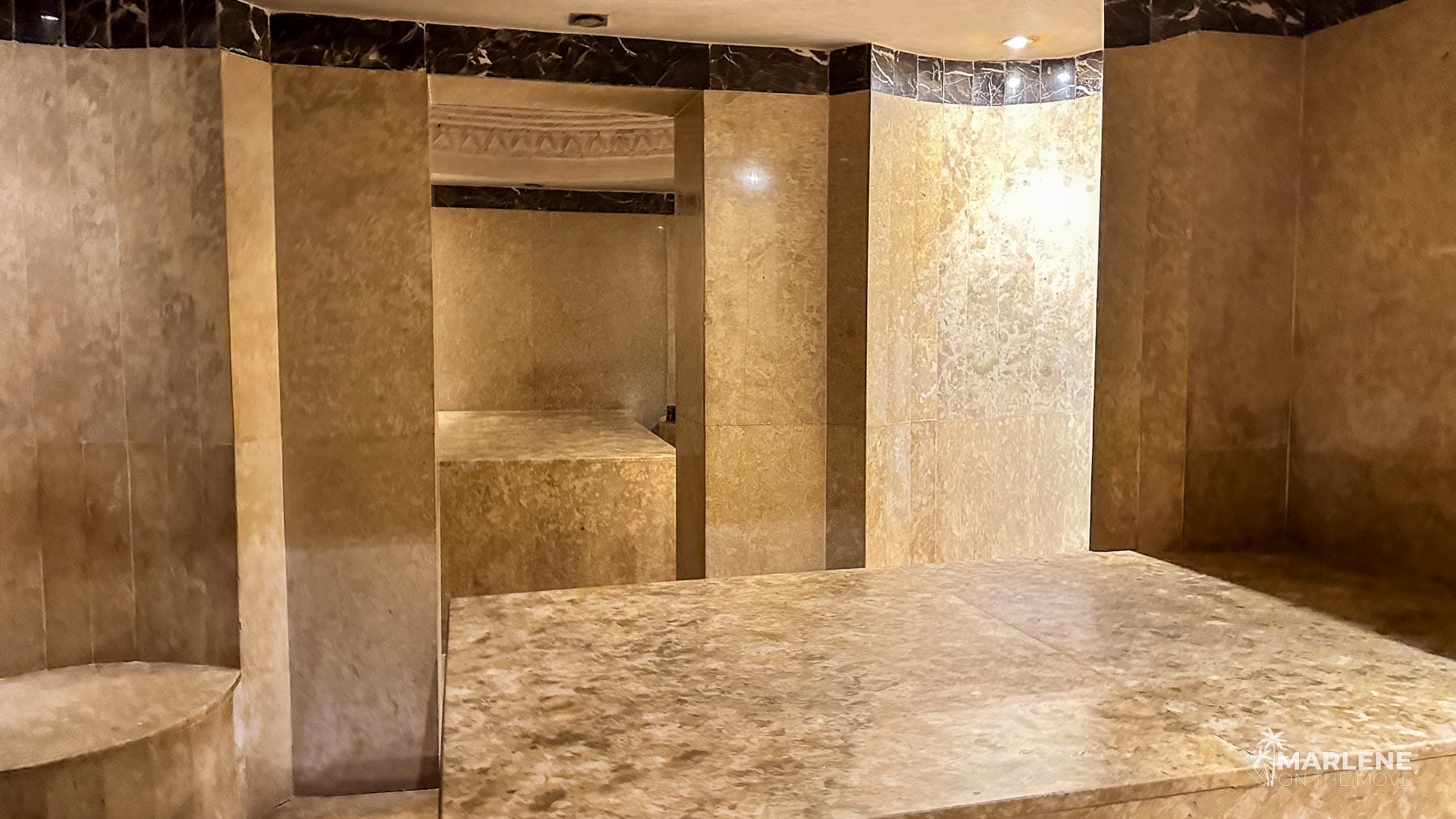
When I walked in, shoes and expectations left at the door, I quickly understood this wasn’t going to be a massage with candles and ambient music. The room was hot. Very hot. The marble slab I lay down on was hot. The air was hot. The point, I later understood, is exactly that: the heat opens your pores and prepares your skin to absorb everything that comes next.
The process has several stages. First comes hot water — quite hot, it should be said — poured over the body to begin softening the skin. Then the ghassoul, a Moroccan clay with deep cleansing properties, is applied. There’s a moment with traditional black soap. Each step has its purpose, and the therapist moves through the ritual with the ease of someone who has done this hundreds of times… because she has.
And then comes the exfoliation.
I’ve had massages my whole life. I always go for the relaxing, gentle kind. I’m not someone who asks for the knots to be worked out at full force. But the hammam isn’t a massage. The kessa glove is rough by design, and the exfoliation is deep, deliberate, and very disconcerting if you’re not used to it. It’s not painful, but it’s very intense. The sensation is that someone is literally scraping your skin, which is, in a sense, exactly what’s happening. Dead skin you didn’t know you had comes off in visible rolls.
I mentally compared it to being grated like cheese. It both amused and mildly alarmed me.
A hair treatment was also included, which I hadn’t expected and was a welcome surprise. In more complete hammam packages at spas (which wasn’t my case), the session ends with a relaxing massage that I imagine makes a real difference.
What nobody tells you before you go in
The heat is real, and it’s constant. Not the kind of heat you get on a summer afternoon. It’s enclosed, humid heat that doesn’t let up. If you tend to have low blood pressure or are sensitive to temperature changes, be prepared for some light-headedness, especially at the start. That’s not a reason to skip it, but it is a reason to pace yourself and let the therapist know if you need a moment.
As for clothing: the honest answer is you don’t need much. At the hammam I visited, they provided disposable underwear… and that was it. No swimsuit, no specific clothing. If you’re going somewhere that doesn’t provide disposable options, a simple swimsuit works fine, or underwear you don’t mind getting wet.
One last note: the hammam isn’t a conventional spa experience. There’s no hushed atmosphere or retreat-like ambience. It’s a ritual that can feel, at moments, quite physical and direct. But that’s precisely what makes it genuine.
Will I do it every time I visit Morocco?
Probably not.
I enjoyed it more than I expected, given the intensity of the exfoliation. But I didn’t walk out thinking I’d found my favorite wellness ritual. I walked out thinking it was an experience worth having, that it taught me something about Morocco that no guidebook had, and that my skin was, in that moment, in the best condition I’d ever felt it. Soft, hydrated, light, in a way that no cream or at-home scrub can replicate.
Do I still recommend it to first-time visitors? Yes, without hesitation. But now I recommend it with more honesty, because I know what’s actually in there. And that makes all the difference.
Now you: have you ever done a hammam? What do you think about this ritual?
Travel Notes
Duration: between 45 minutes and 1h30 depending on the package.
Where to go: traditional hammams in the medina (more authentic, bring your own supplies) or hotel/riad spas (more accessible for first-timers).
What to bring for a traditional hammam: kessa glove, black soap, ghassoul clay, towel.
What to bring for a hotel/spa hammam: usually nothing — everything is provided. Confirm in advance.
Clothing: disposable underwear is often provided. Alternatively, bring a simple swimsuit.
Low blood pressure or heat sensitivity: take it slow during the warm-up phase and let the therapist know.
Average price: public hammam from €2-5; hotel/spa packages range from €30-80 depending on what’s included.
Best time to visit Marrakech: March-May or September-November for more comfortable temperatures.
Accommodation: look for riads with an in-house hammam for a more immersive experience.
Travel insurance: always Heymondo for Morocco.
Connectivity: Holafly eSIM works well in Morocco.
Final tip: book the hammam for late afternoon. You’ll come out so relaxed you won’t want to do anything else.
Travel Tool Box
These are my go-to tools to make my trips more complete at the best prices. Enjoy some of the perks of being one of my readers.
By using these links you’re also contributing for the maintenance of this blog and for that I thank you so much!
Heymondo
Book your travel insurance with a 5% discount.
Holafly
Get your unlimited eSIM with a 5% discount.
Booking.com
The best stays worldwide at the best prices.
GetYourGuide
Enjoy the best tours and entertainment each destination offers.
Skyscanner
Find the best flight at the best price for your next trip.
Hostelworld
Enjoy the best hotels around the world for a fun experience.
DiscoverCars
Book your car at the best prices and go explore.
Compensair
Don’t let your canceled flight ruin your vacation.